Remove Nano Banana Watermark: Does a Second Pass Change the File?
In two matched-map synthetic PNG tests, selecting the first cleaned download again produced exactly the same file bytes. The second pass did not improve or worsen either saved result. That is a measured repeat-processing result, not evidence that every Nano Banana image becomes perfectly clean.
One question: what changes on a repeat run?
This experiment varies the processing count while keeping each file, default controls and production engine fixed. It covers two synthetic scenes at 1024 × 768 and 1200 × 896 pixels, with clean and matched-star versions of each. We selected all four source files through the public homepage picker in the desktop in-app browser, then selected each first marked-file output again: six selections and six actual downloads. Controls remained Auto, zero offsets and strength 1.00.
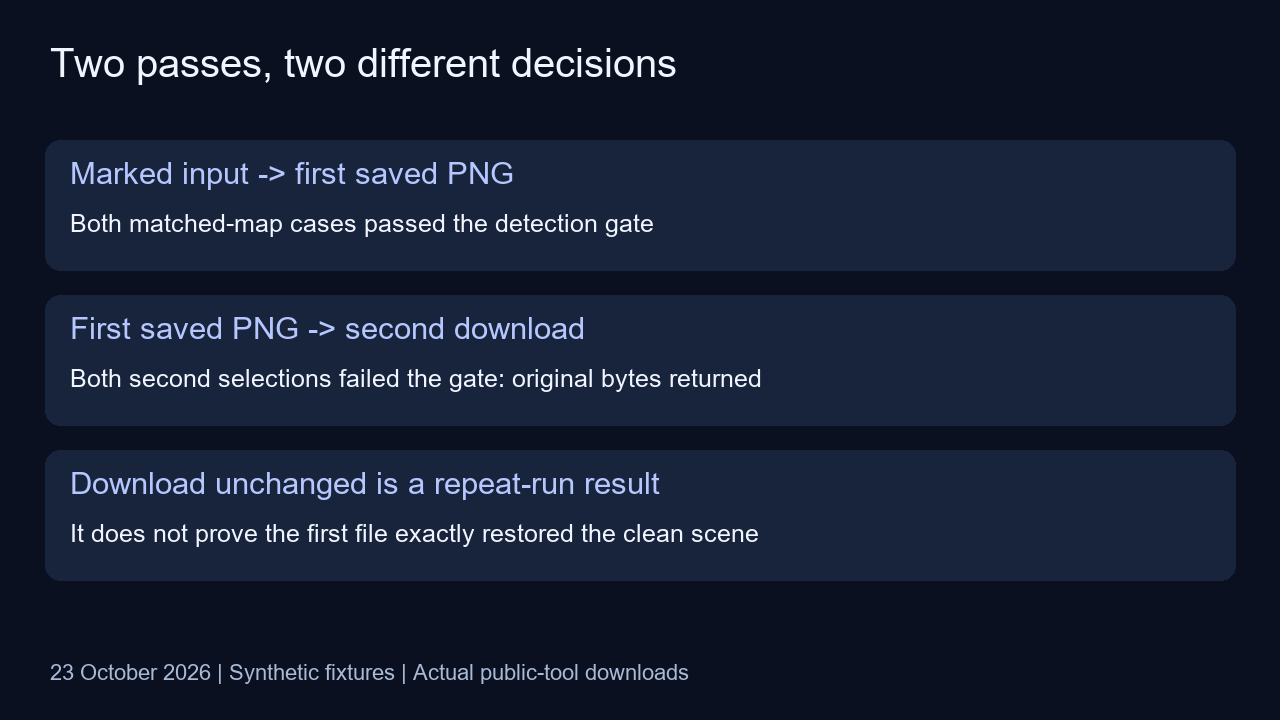
The first pass changed the star area
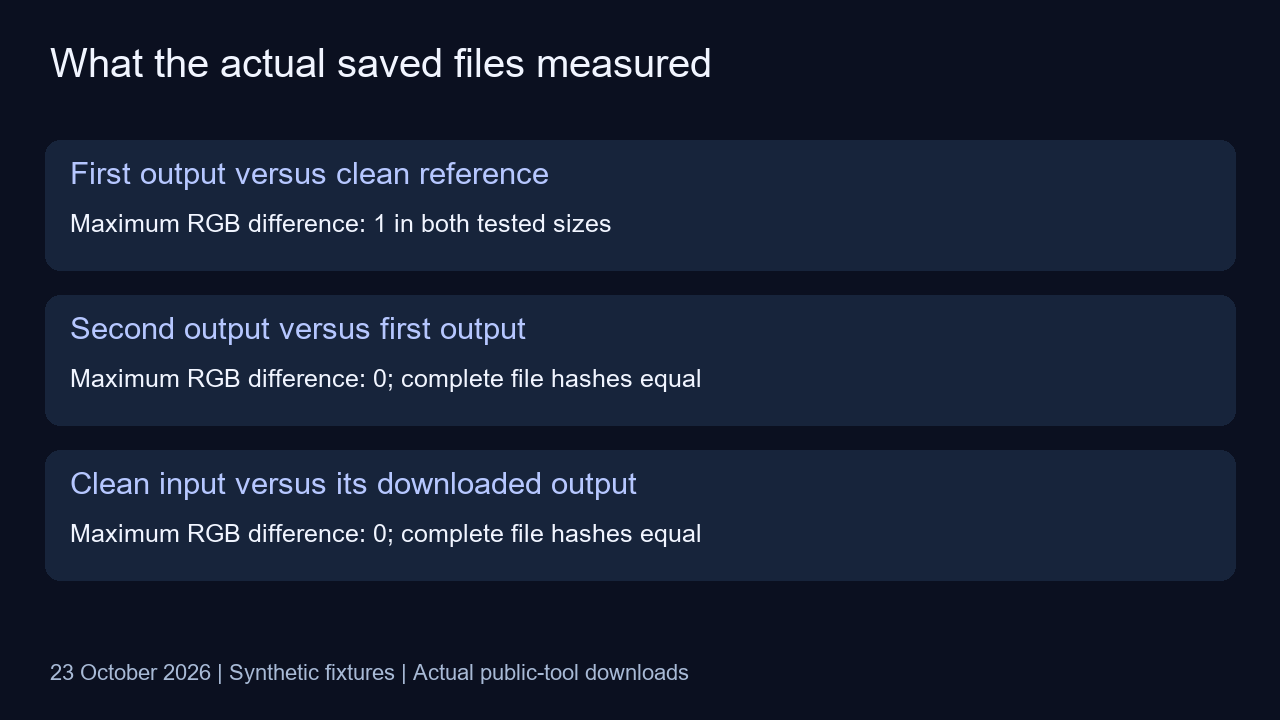
For the 1024 × 768 case, the known synthetic star occupied the 48 × 48 rectangle starting at (944, 688). The first saved PNG differed from the clean reference at 413 pixels, with a maximum RGB-channel difference of 1 and a rectangle mean absolute channel difference of 0.07074652777777778. Outside that rectangle, zero pixels changed relative to the marked input. A nearly restored image and an identical original are therefore different results in this case.
For the 1200 × 896 case, the matched star occupied the 96 × 96 rectangle starting at (1040, 736). The first output differed from the clean reference at 3114 pixels; its maximum RGB-channel difference was also 1 and its rectangle mean absolute channel difference was 0.18323206018518517. Again, zero pixels outside the known star rectangle changed relative to the marked input. These are decoded pixel measurements of the saved downloads, not judgments based on a small preview.
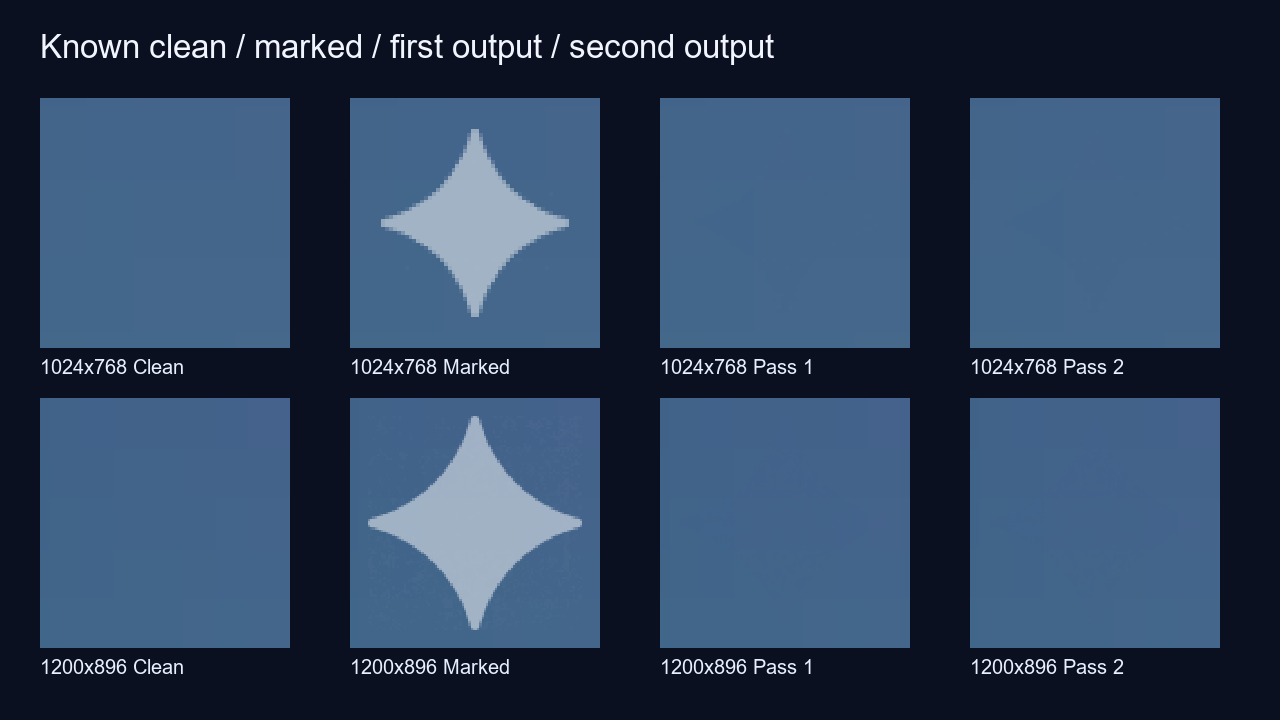
The second pass preserved the first file
Both marked source selections passed the visible-star gate. When their first saved PNGs were selected again, both second selections failed that gate. In each size, the second download had the same complete-file SHA-256 as the first download, zero changed RGB pixels and a maximum RGB difference of 0 versus that first file. The small first-pass differences from the clean reference remained; the second pass neither removed those differences nor introduced new ones. This separates repeat-run stability from restoration accuracy.
The two clean controls also failed the gate. Their downloaded files matched their respective inputs byte-for-byte, and their maximum RGB difference was 0. This checks the unmodified-file route for these two controls only; it does not establish a false-positive rate across other clean pictures.
How to use this result
Keep the original file and inspect the downloaded corner before deciding whether it meets your needs. If an outline remains, repeating the same file with the same controls is not a demonstrated repair: these two repeat runs returned unchanged files. My stopping recommendation is to return to the original when considering alignment adjustments, rather than treating another download as proof of improvement. This is editorial guidance, not a tested outcome for other backgrounds or settings.
Scope, measurements and records
These are matched-map synthetic samples, not native Gemini or Nano Banana downloads and not a real-image success rate. SynthID removal, metadata retention and phone processing were not tested. The default detection and removal code was not changed. A zero second-pass difference describes stability only; it does not promise complete watermark removal on every image.
Maximum RGB difference means the largest absolute channel difference after decoding both saved files to RGB, on the 0–255 scale. A changed pixel has at least one unequal RGB channel. Rectangle mean absolute difference averages all RGB-channel errors inside the known synthetic mark rectangle. Byte identity compares the SHA-256 of the entire downloaded file, including its encoding. The clean reference, marked source and first output are different comparison baselines.
Download the CSV, full measurements and file hashes, or synthetic fixtures, actual downloads and browser receipts. Shared encoding and measurement caveats are documented in the shared methodology.
This page isolates repeat processing. For other variables, see file admission and saved formats, JPEG compression, resampling and transparency. The homepage guide explains position and strength controls; this page does not repeat that tutorial.