Why can a resized Gemini screenshot leave a watermark outline?
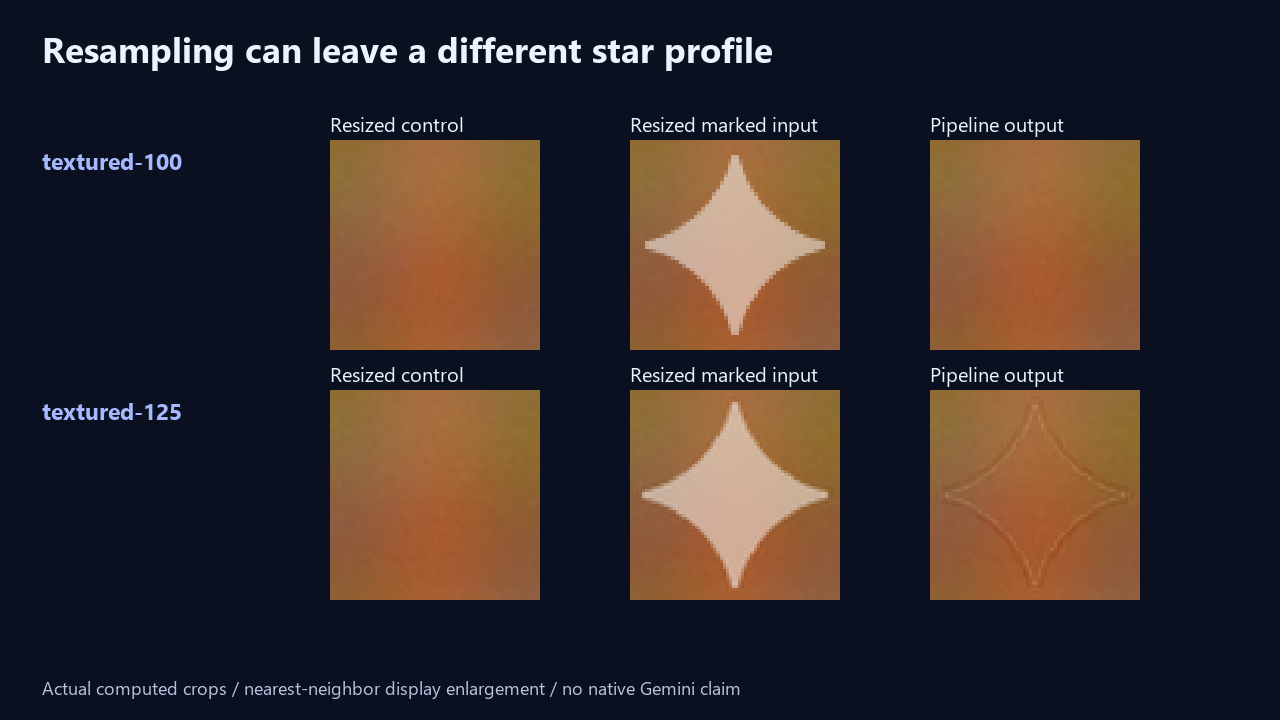
Resizing can change a visible sparkle’s position, size, and edge pixels. In our controlled PNG test, the current remover located every tested scaled mark, yet the resized cases retained more pixel error than the unscaled controls. Return to the original download before increasing strength or repeatedly processing a screenshot. The measurements below concern synthetic resized fixtures, not actual Gemini screenshots or a real-image success rate.
What we resized and what stayed fixed
On 20 October 2026, we tested a smooth scene and a textured scene using the current production detection gate followed by the unchanged inverse-blend function. Each source was 1024 by 768 pixels, with a known synthetic 48-pixel sparkle at x=944, y=688. We retained the unmarked source for each scene. These are controlled same-map fixtures: no native watermarked Gemini download was used.
We resized the marked input and its unmarked control separately to 768 by 576, 1024 by 768, and 1280 by 960 pixels, using Pillow LANCZOS. Each result was stored as PNG. The three scale factors were 0.75, 1.00, and 1.25. This deliberately varies resampling while avoiding a new JPEG encoding stage; it is a different experiment from our JPEG compression article.
Every case used Auto mode, zero horizontal and vertical offsets, and strength 1.00. We executed the exact production watermark-gate.js, alpha-maps.js, and extracted applyRemoval function in Node. We did not adjust thresholds, weaken removal, or retune an individual image. The downloadable JSON records the source hashes, engine hashes, chosen candidate boxes, and both detection scores.
Location matched; restoration still differed
All six tested candidates passed the current two-condition gate. The selected cleanup boxes were 36 pixels at x=708, y=516 for the smaller image, 48 pixels at x=944, y=688 at the original size, and 60 pixels at x=1180, y=860 for the enlarged image. That result rules out a missed location in these particular cases. It does not prove the same behavior for arbitrary crops or screenshots.
For the smooth scene, output corner mean absolute error against the identically resized unmarked control was 1.1240 at scale 0.75, 0.1354 at scale 1.00, and 1.2270 at scale 1.25. For the textured scene, it was 0.9740, 0.1331, and 1.0640 respectively. Those numbers describe RGB channel differences, not percentages, detection confidence, or visual-quality ratings.
The largest channel differences in the resized smooth cases were 22 and 27; the resized textured cases were 20 and 25. Both unscaled cases had maximum difference 1. Every pipeline result changed zero pixels outside its actual selected box relative to its own decoded input. Resampling had already affected the input before cleanup, so that outside-box check cannot certify recovery of the original full scene.
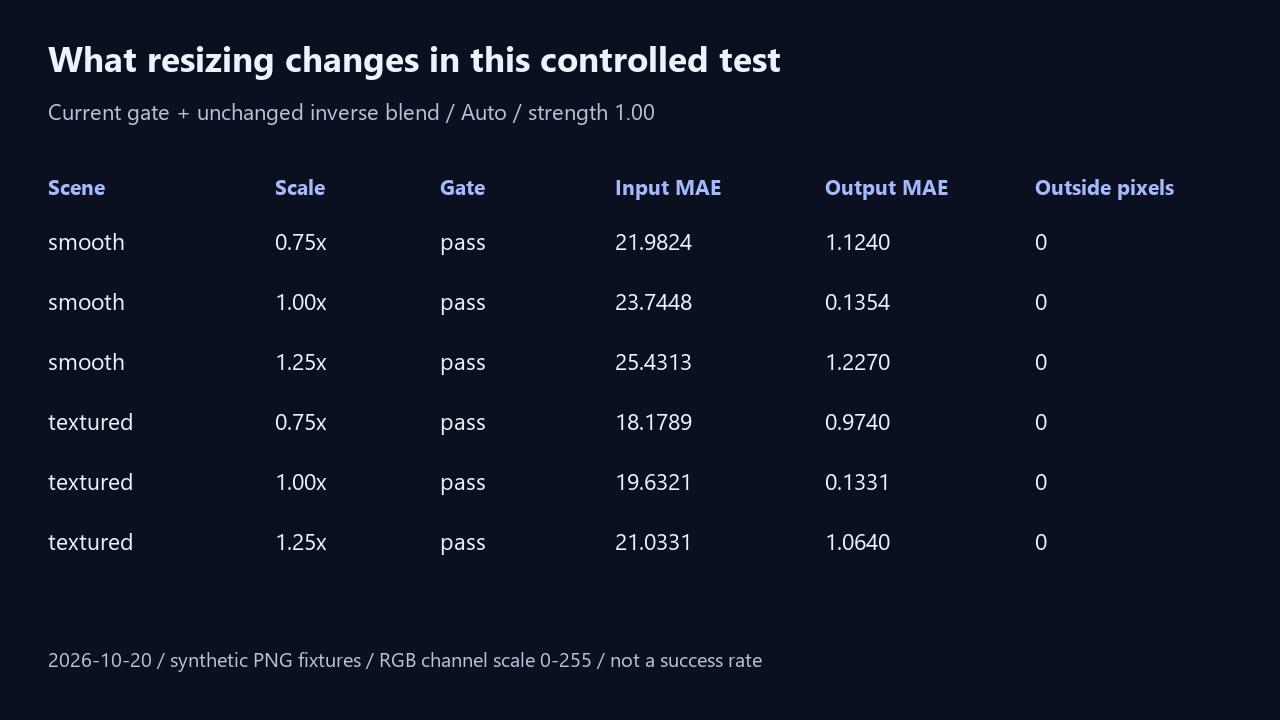
| Scene | Scale | Size | Gate | Input MAE | Output MAE | Output maximum | Outside pixels |
|---|---|---|---|---|---|---|---|
| Smooth | 0.75 | 768×576 | Pass | 21.9824 | 1.1240 | 22 | 0 |
| Smooth | 1.00 | 1024×768 | Pass | 23.7448 | 0.1354 | 1 | 0 |
| Smooth | 1.25 | 1280×960 | Pass | 25.4313 | 1.2270 | 27 | 0 |
| Textured | 0.75 | 768×576 | Pass | 18.1789 | 0.9740 | 20 | 0 |
| Textured | 1.00 | 1024×768 | Pass | 19.6321 | 0.1331 | 1 | 0 |
| Textured | 1.25 | 1280×960 | Pass | 21.0331 | 1.0640 | 25 | 0 |
How to read the comparison
We compared each output with its own unmarked control resized through the same path. The measurement rectangle is the original sparkle box scaled using floor and ceiling at its boundaries, then padded by four pixels on every side. Including this border avoids measuring only the center of the star while excluding edge changes caused by resampling. The JSON retains each rectangle’s exact coordinates.
Mean absolute error is the sum of absolute output-versus-control RGB differences in that rectangle, divided by rectangle width times rectangle height times three channels. Maximum error is the largest individual channel difference there. RGB values range from zero to 255. The table rounds mean errors to four decimal places; the CSV and JSON preserve the measured values.
Our interpretation is limited: changing the sampled edge profile can leave residual error even when the current proportional candidate frame matches. It follows from the paired inputs, fixed processing settings, selected boxes, and measured residuals. It is not a measured explanation for every screenshot failure. A browser screenshot may involve cropping, overlays, display scaling, or another encoding path that this experiment did not reproduce.
What to try with your own file
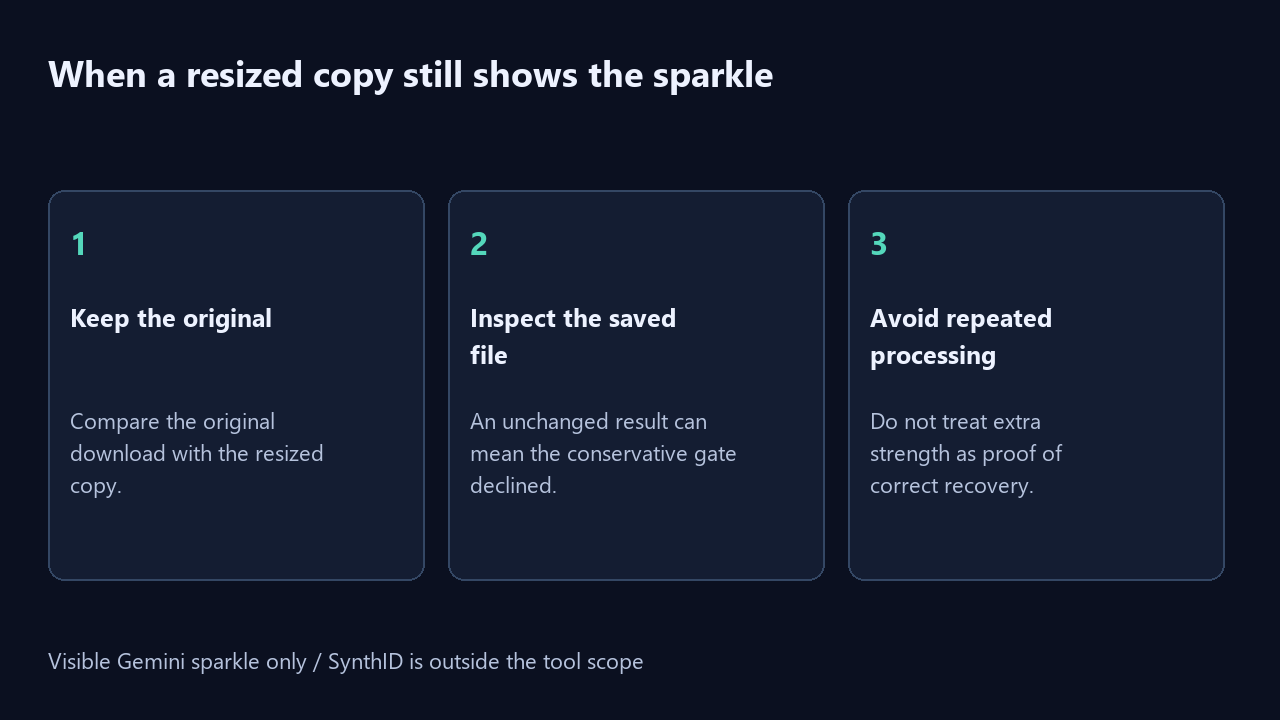
Keep the original download and the screenshot as separate files. Compare them at the same display scale, then inspect one saved cleanup result. If only the resized copy leaves an outline, use the earlier original for the next attempt rather than repeatedly cleaning the already processed output. This is a practical review sequence, not a guaranteed recovery method.
The current tool uses a conservative shape check and a trial-removal check before editing. When evidence is insufficient, its browser download returns the original file bytes. An unchanged download therefore does not by itself show that removal ran in the wrong direction. Our six scale cases passed the gate; this experiment did not measure how often other files are declined.
Questions about resized screenshots
Does a larger cleanup box always solve a resized watermark? No. The tested scaled boxes matched the known positions and sizes, but residual error remained. This test did not compare manual size overrides, so it does not establish a preferred override for your file.
Will increasing strength restore the missing detail? This test kept strength at 1.00 and provides no evidence for that promise. Preserve the original and review the saved corner rather than treating a stronger setting as proof of correct restoration.
Does this remove invisible SynthID? No. WatermarkUndo targets the visible Gemini sparkle. SynthID and other invisible provenance signals are outside its scope.
Limits and reproducible records
The positive samples were synthesized using the site’s own alpha map on two previously recorded artificial scenes. This is a matched-template controlled test, not independent evidence of compatibility with all Gemini exports. It was executed in an isolated Node runner, not by downloading the six outputs from a browser. We did not measure browser file-byte identity, phone performance, metadata retention, or native screenshot behavior.
The experiment used the production engine hashes listed in the JSON and the installed Pillow version recorded there. The downloadable reproduction package includes the four source files, three engine snapshots, method, and runner. It requires Python with Pillow and NumPy, plus Node.js. Reproducing the experiment does not require an account, a private token, or sending an image to our server.