Nano Banana Pro Watermark: Measure the Mark, Not Just the Canvas
A Nano Banana Pro watermark cannot be diagnosed from a “4K” label alone. In our controlled 4800 × 3584 pair, the fixed 96-pixel mark came back byte-for-byte unchanged, while the proportional 384-pixel mark changed 73,005 pixels and finished within one RGB level of the clean reference. These are three actual desktop tool downloads of synthetic inputs, not native Pro images or a real-image success rate.
Canvas size is not a mark measurement
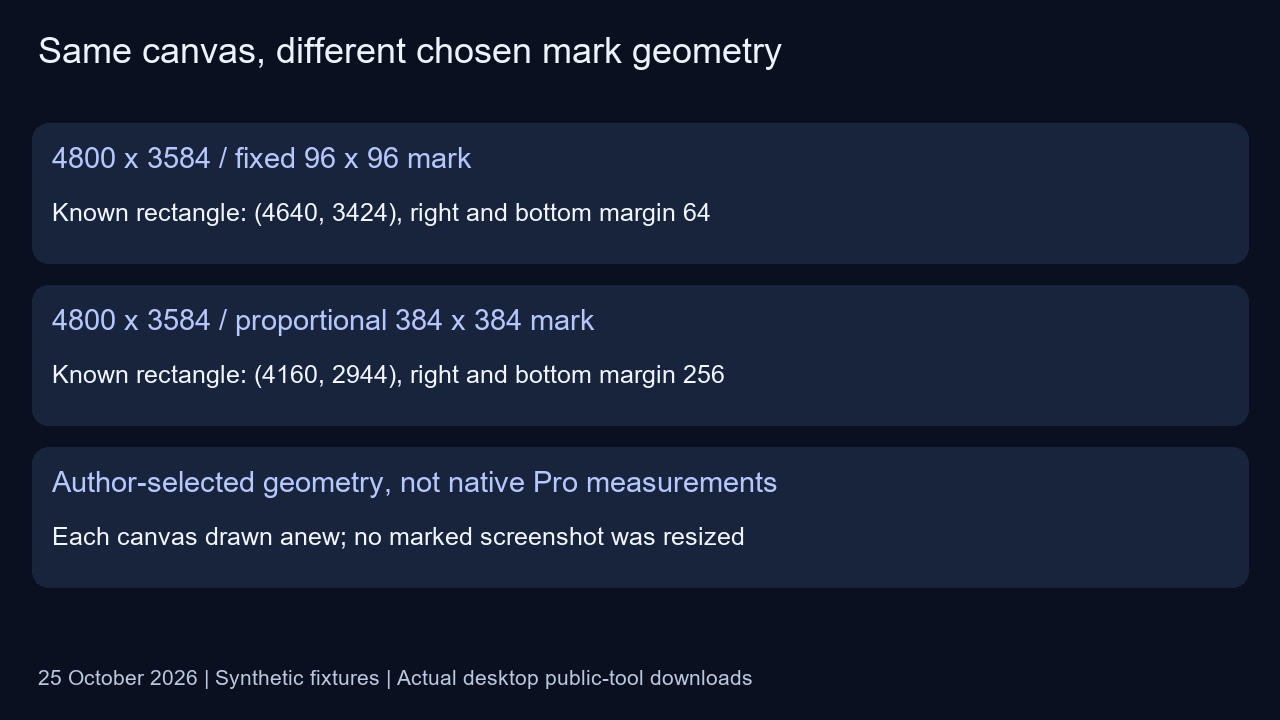
Google’s image-generation documentation lists a Pro Image 4:3 family of 1200 × 896, 2400 × 1792 and 4800 × 3584. Those are canvas dimensions. Our mark sizes and margins below are author choices, not a claim about the logo geometry in Google’s native downloads. The model and resolution labels alone do not establish a visible-mark rectangle.
Source: Google image-generation documentation, inspected 25 October 2026.
Each synthetic canvas was drawn anew. The large fixed route placed a 96 × 96 mark at (4640, 3424), with 64-pixel right and bottom margins. The proportional route used a 384 × 384 mark at (4160, 2944), with 256-pixel margins. The 1200 × 896 baseline used 96 × 96 at (1040, 736). We did not resize a marked screenshot. In the wider local protocol, fixed and proportional routes share the same baseline bytes; that is one input, not two independent observations.
What the actual downloads changed
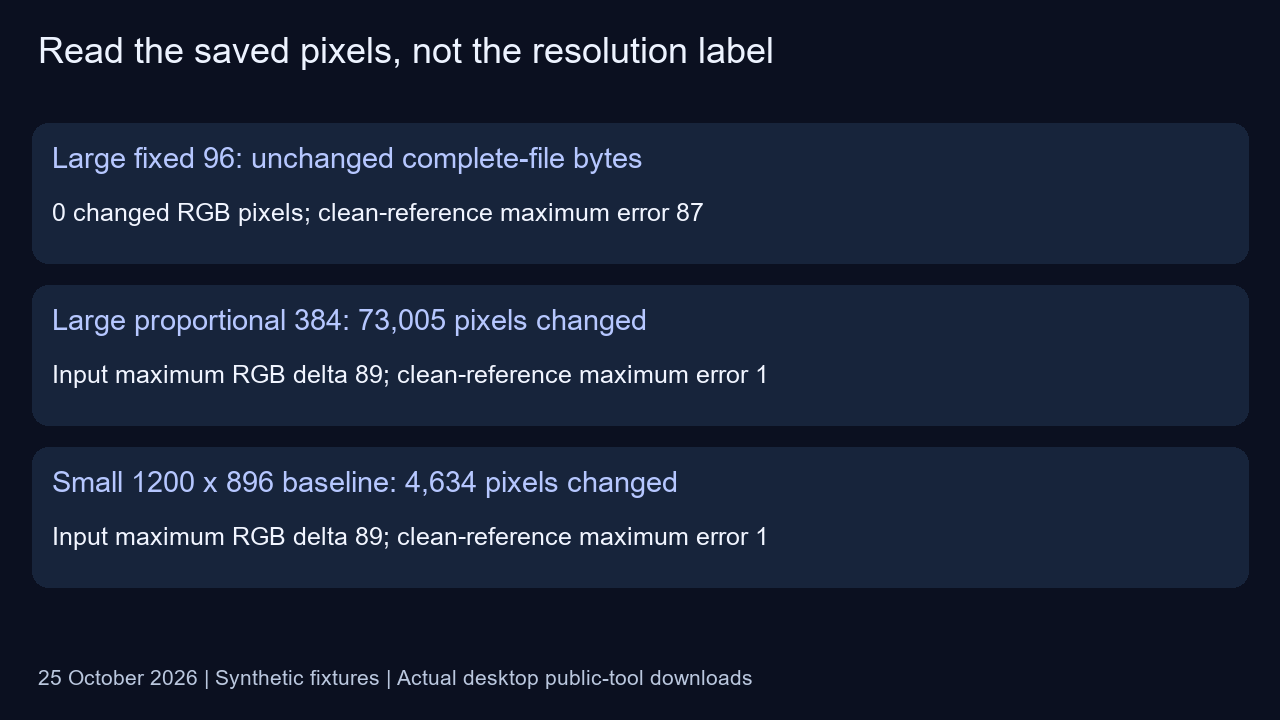
We selected each input through the public homepage picker, left Auto, both offsets at zero and strength at 1.00, and saved the real Download cleaned PNG result. The table measures those files. The large fixed-mark output preserved the input’s complete-file SHA-256. An unchanged file still retained maximum RGB error 87 against its clean reference; that is preservation, not successful removal.
| Canvas / mark | Changed RGB pixels | Max input delta | Max reference error | Identical bytes |
|---|---|---|---|---|
| 1200x896-fixed96 | 4634 | 89 | 1 | No |
| 4800x3584-fixed96 | 0 | 0 | 87 | Yes |
| 4800x3584-proportional | 73005 | 89 | 1 | No |
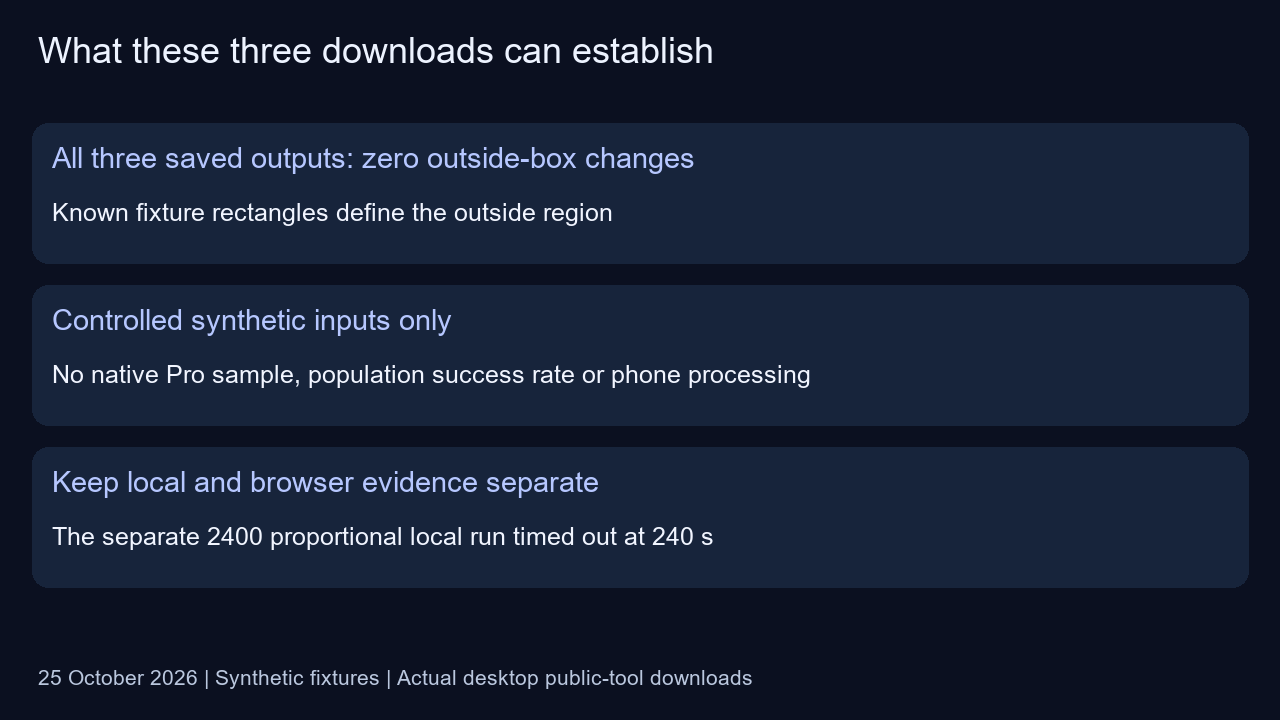
The large proportional-mark download changed 73,005 pixels, with maximum RGB delta 89 from its input and maximum reference error 1. The small baseline changed 4,634 pixels, also with input delta 89 and reference error 1. All three downloads changed zero pixels outside their known fixture rectangles. These bounded results do not predict performance on other pictures.
Scope and a separate local timeout
The separate copied-engine local diagnostic included a 2400 × 1792 proportional case that exceeded a 240-second computation limit. Its gate decision and error remain unknown. It was not one of these three public-browser downloads. A timeout is not rejection, zero error or proof of a browser timeout.
The production detection, removal and alpha-map files were unchanged. Inputs were author-created synthetic samples, not native Gemini or Nano Banana Pro downloads. SynthID removal, metadata retention and phone processing were not tested. WatermarkUndo addresses the visible Gemini sparkle; these results do not make it a general watermark eraser.
A changed pixel has any unequal decoded RGB channel. Maximum difference is the largest absolute RGB-channel error on the 0–255 scale. Outside counts use the known fixture rectangle. See the shared methodology for common definitions.
Download the CSV, results and file hashes, and inputs, clean references and actual downloads. This page separates canvas dimensions from mark geometry; the resampling experiment instead rescales a marked raster. File admission, repeat processing and nonmatching mark shapes test different variables.