AI Image Watermark Remover: Which Corner Marks Stay Unchanged?
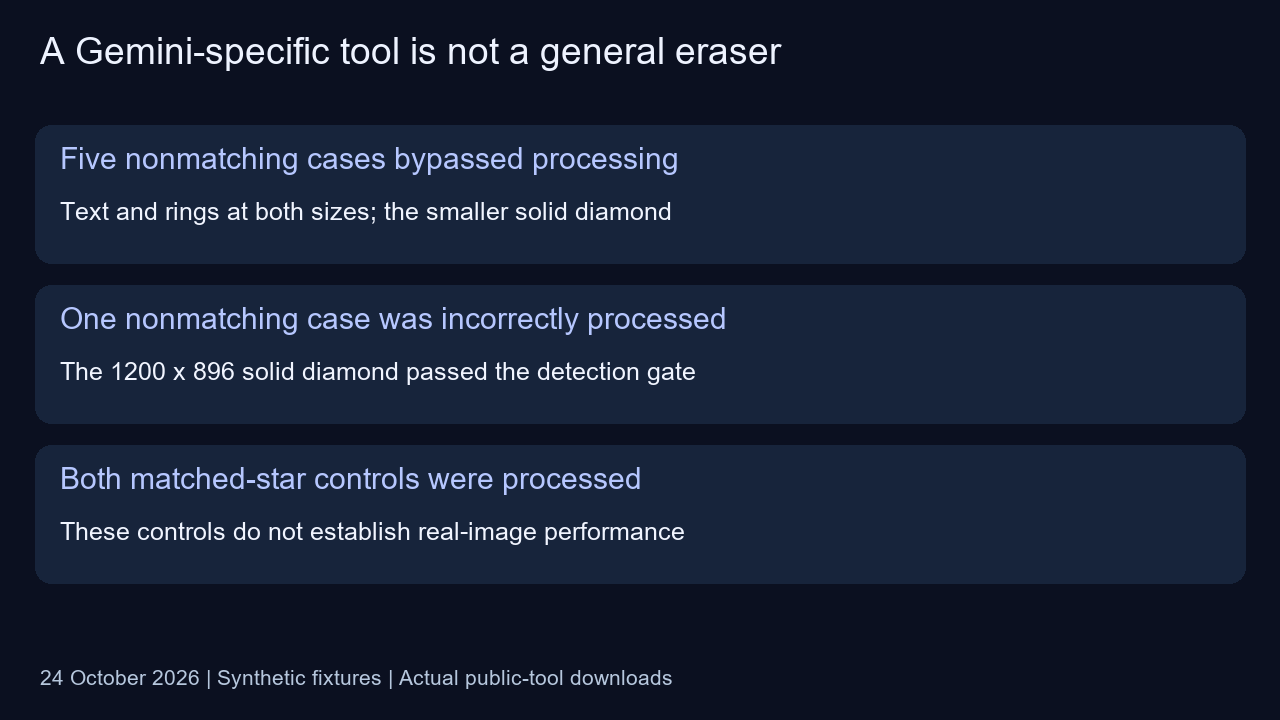
In eight controlled synthetic-image downloads, WatermarkUndo returned five nonmatching corner marks unchanged, but incorrectly processed one large solid diamond. Both matched-star controls were processed. For an AI image watermark remover, accepting a file is therefore not proof that its mark matches the Gemini sparkle or that the downloaded corner is correct.
The variable: the shape in the corner
We created text reading TEST, an outlined ring, a solid diamond and a matched-star control on each of two known backgrounds. The canvas sizes were 1024 × 768 and 1200 × 896 pixels. The known mark rectangles were respectively 48 × 48 at (944, 688) and 96 × 96 at (1040, 736). Each input was selected through the public homepage picker and its actual download saved in the desktop in-app browser. Controls stayed at Auto, zero offsets and strength 1.00.
Five nonmatching marks stayed unchanged
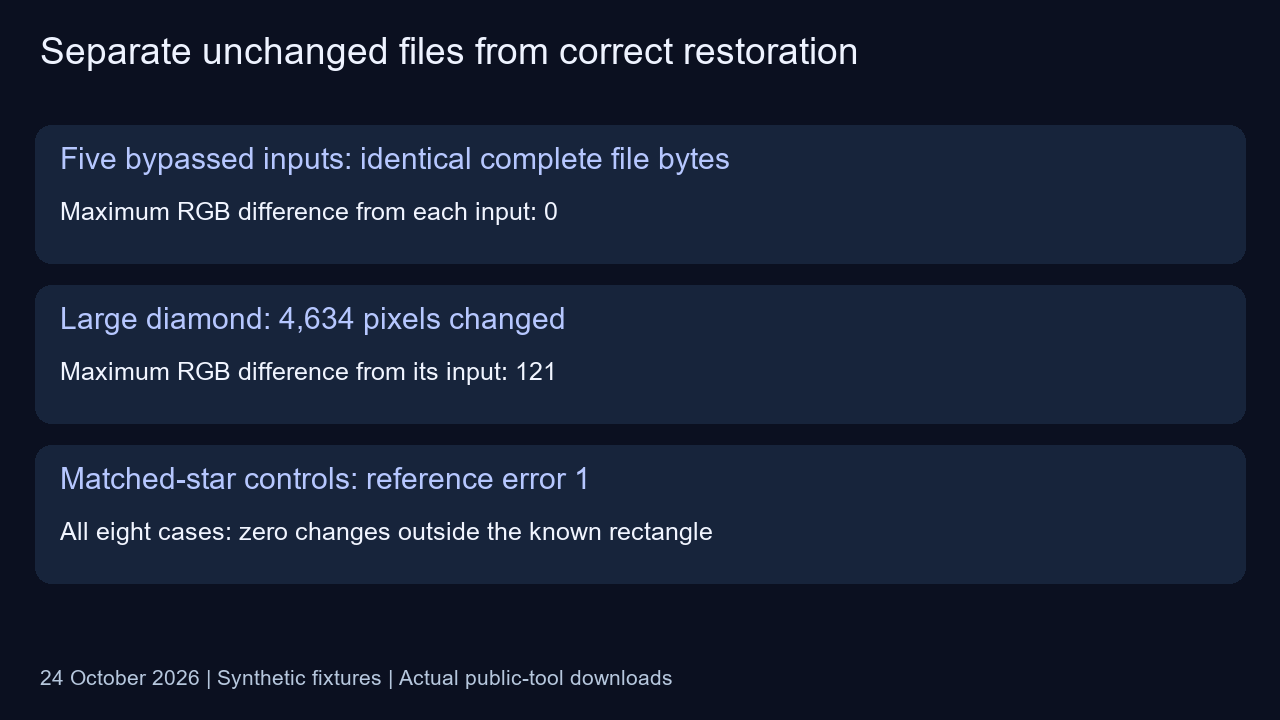
Text and ring inputs at both canvas sizes, plus the smaller solid diamond, failed the visible-star detection gate. Every corresponding download matched its input byte-for-byte: equal complete-file SHA-256, zero changed RGB pixels and maximum RGB difference 0. The tool preserved these files; it did not erase their marks. Relative to their clean references, the maximum RGB difference remained 116 for the smaller fixtures and 118 for the larger text and ring.
| Canvas / mark | Gate passed | Changed pixels vs input | Max RGB delta vs input | Identical file bytes |
|---|---|---|---|---|
| 1024 × 768 / text | No | 0 | 0 | Yes |
| 1024 × 768 / ring | No | 0 | 0 | Yes |
| 1024 × 768 / diamond | No | 0 | 0 | Yes |
| 1024 × 768 / matched-star | Yes | 883 | 83 | No |
| 1200 × 896 / text | No | 0 | 0 | Yes |
| 1200 × 896 / ring | No | 0 | 0 | Yes |
| 1200 × 896 / diamond | Yes | 4634 | 121 | No |
| 1200 × 896 / matched-star | Yes | 4634 | 85 | No |
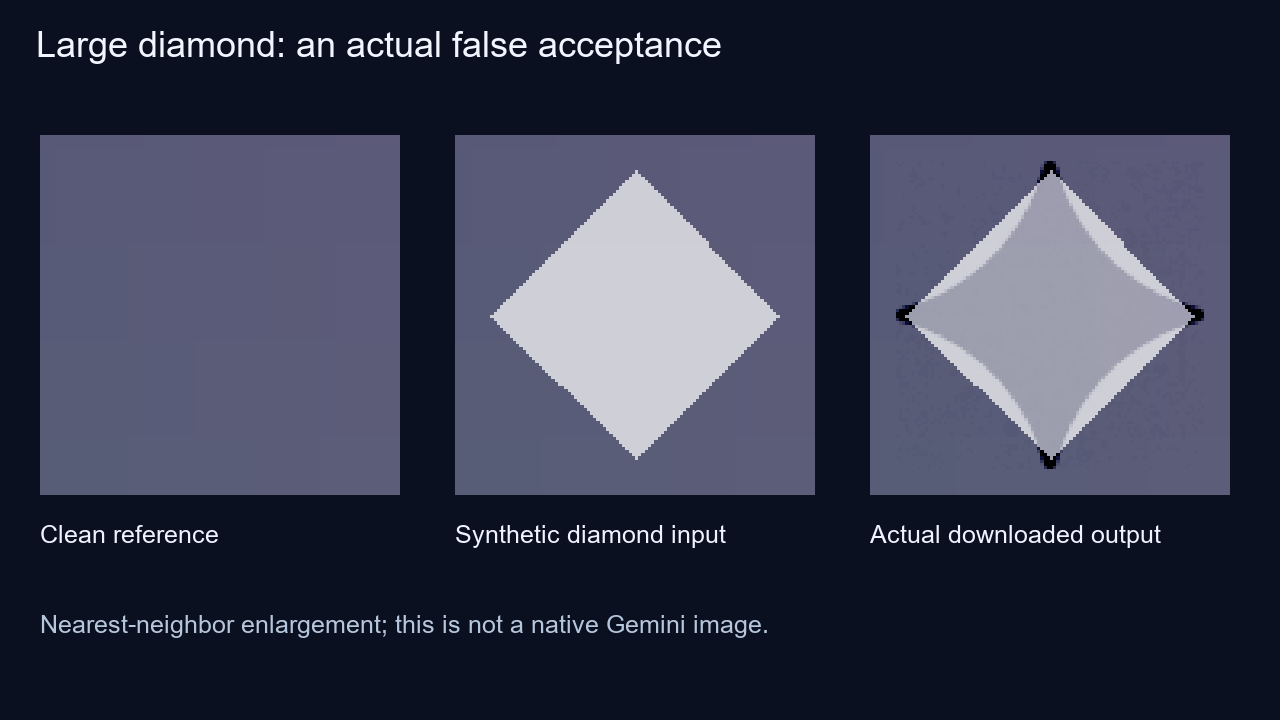
The larger diamond exposed a false acceptance
The 1200 × 896 solid-diamond fixture passed the gate even though it was not the matched-star control. Its downloaded output changed 4,634 pixels relative to the input, with a maximum RGB-channel difference of 121. Its maximum difference from the clean reference was also 121. This is an observed false acceptance in this fixture: processing altered a nonmatching mark instead of establishing that the intended Gemini pattern was present. The unchanged smaller diamond does not cancel this larger-case failure.
Matched stars provide a different comparison
The matched-star controls passed the gate at both sizes. Their downloaded outputs changed 883 and 4,634 pixels respectively, with maximum RGB differences from their inputs of 83 and 85. Both outputs had a maximum RGB difference of 1 from the known clean reference. Zero pixels outside the known mark rectangle changed in any of the eight cases. An unchanged outer region alone did not distinguish the accepted star from the incorrectly accepted large diamond.
Use the scope check before trusting a result
WatermarkUndo targets the visible Gemini sparkle at supported placements. A label such as AI image watermark remover does not make this a general eraser for arbitrary text, rings or logos. Keep the source and review the saved corner. The gate decision is one diagnostic, not a guarantee. That caution is supported here by the specific large-diamond failure; it is not a measured failure rate for real photographs.
Scope and reproducible records
These are author-created synthetic samples, not native Gemini or Nano Banana downloads and not a real-image success rate. SynthID removal, metadata retention and phone processing were not tested. The production detection and removal code was not changed for this experiment. The mark shape was the variable; backgrounds and sizes were deliberately limited. This experiment cannot establish how often other unrelated marks will pass or fail.
A changed pixel has at least one unequal decoded RGB channel. Maximum RGB difference is the largest absolute channel difference on the 0–255 scale. Outside-region counts use the known fixture rectangle, including when the tool rejects the input; they do not use a guessed detection box. Complete-file byte identity is checked separately through SHA-256. Reference error and change from input answer different questions.
Download the CSV, measurements and file hashes, or fixtures, actual downloads and browser receipts. The shared methodology holds common measurement caveats.
This page isolates nonmatching shapes. See file admission, repeat processing, resampling and transparency for separate variables.